Future City Celebration with Elysium School is scheduled for Monday, February 9th at 1:00. We will have a chance to share our Future City Models with each other, present and celebrate with cupcakes:) We will final confirmation as soon.
We begin our new World of Work Project this week. We’d love to have the kids listen to different people’s stories to realizing their life passions and work, so the kids get a sense for how individual this process is, that it looks different for everyone and that most often it is a gradual figuring out process. If you’d like to share your story or know anyone whose story the kids might enjoy hearing, please reach out to let us know.
We will have our Writer’s Celebration this week! I’m excited to share the presentation slides with all the kids’ stories and celebration of their growth as writers with all of you later this week.
World of Work Project:
Our goals for this individual project include:
Offering opportunities for the kids to connect to their own unique way of being. Discovering all the many things they love and are good at can help them connect to their gifts.
Recognition that our path to knowing who we are and what we’d like to contribute to our communities takes all different forms for different people at different times.
Realizing that the more trust we have for ourselves and the more we learn to listen to our body, mind, and heart, the easier it will be for us to make choices about how our life unfolds for us.
Discovering and exploring lots of possibilities for work that can align with their individual strengths, gifts and passions.
We were so excited to finish our model and share our presentation with the Future City Competition judges. This year’s challenge was to create a city 100 years in the Future with a Zero Waste City Farm to Table Using a Circular Economy. We create Yukiville! Have a look at all the learning and working together we did to write an essay, create a model and give a presentation to share our city.
Future City Competition is quickly approaching, and we all are working hard to get ready. Please don’t forget to mark January 23rd and 24th on your calendars for the competition. Many of you have booked a hotel for your family to go on Friday and attend the competition on Saturday with your child. For any family members planning on driving up for the competition on Saturday, it is at NC State, The Mc Kimmon Center from 9-4. More specifics to come later this week.
Our next project is “The World of Work”. Whereas our Future City Project was a big group project focused on teamwork and collaboration, this project is more individualized. We will explore different areas of work (non-profit, entrepreneurial and working for an existing company or business) as part of this project as well as explore career pathways based on individual interests. Please share any connections you may have for any career path. We would love to venture out to visit, actively participate or interview people to learn more about the careers that align with our interests 🙂 If you would like to share your line of work with the kids or your pathway to discovering the work you love, please let us know. We’d love for the kids to understand that they are each uniquely purposed to do beautiful things in our world and that the pathway to discovery is unique to each person.
We were so excited to get back to work together this week. Scott and I missed the kids and couldn’t wait to hear all the stories about their break! We have the BEST TEACHING JOB ever. We all grow in community with each other, and your kids are teachers for us and each other too!
Celebrating the New Year Together
On Monday, we celebrated the New Year together by honoring our individual growth this year. Small moments and big moments all come together to create opportunities for growth. We borrowed an Instagram trend to celebrate. I made a cake with lots of sparklers, and we each wrote down moments of growth from this past year. It warmed my heart and affirmed our mission to hear both Luka and Jaden express that they found a school where they feel safe, respected and valued. They not only fit in, they belong and hopefully know how much everyone here is valued for their unique ways of being that they add to our collective whole. Sterling shared progress on her business with “1,000 followers for Winston”. Lili shared her growth in becoming an artist who draws, Laurence shared that he got the e-bike he’d been advocating for while Ollie celebrated the writer within him, and the choice to read “The Summer I Turned Pretty”.
Future City Project…Science and Social Studies
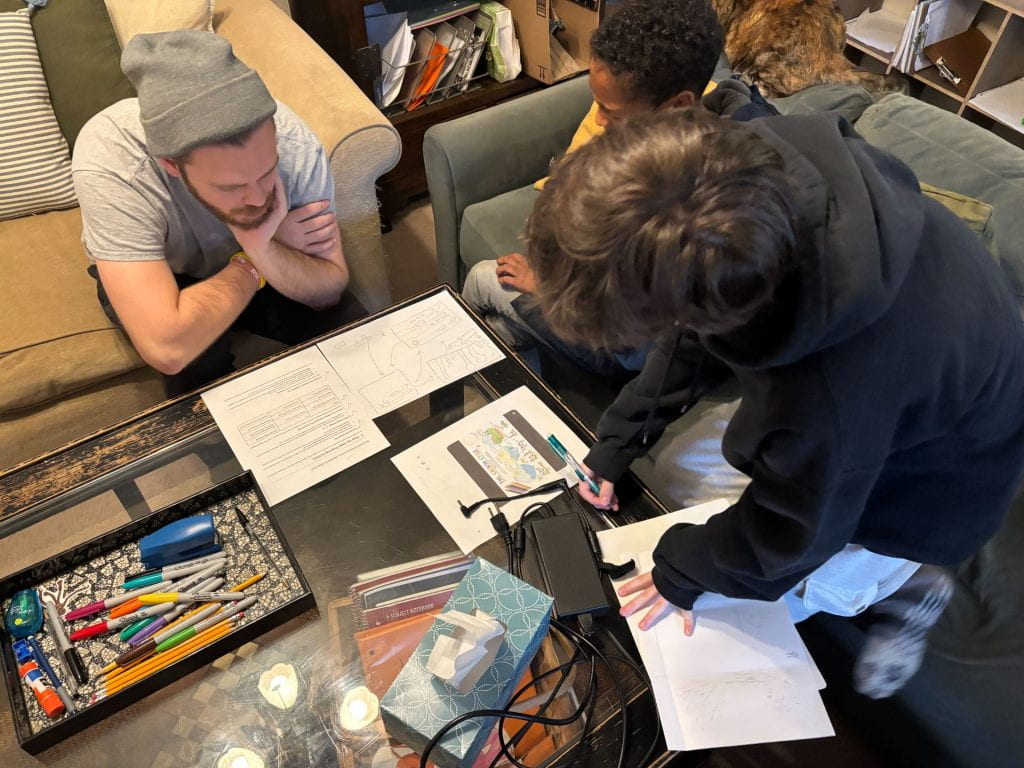
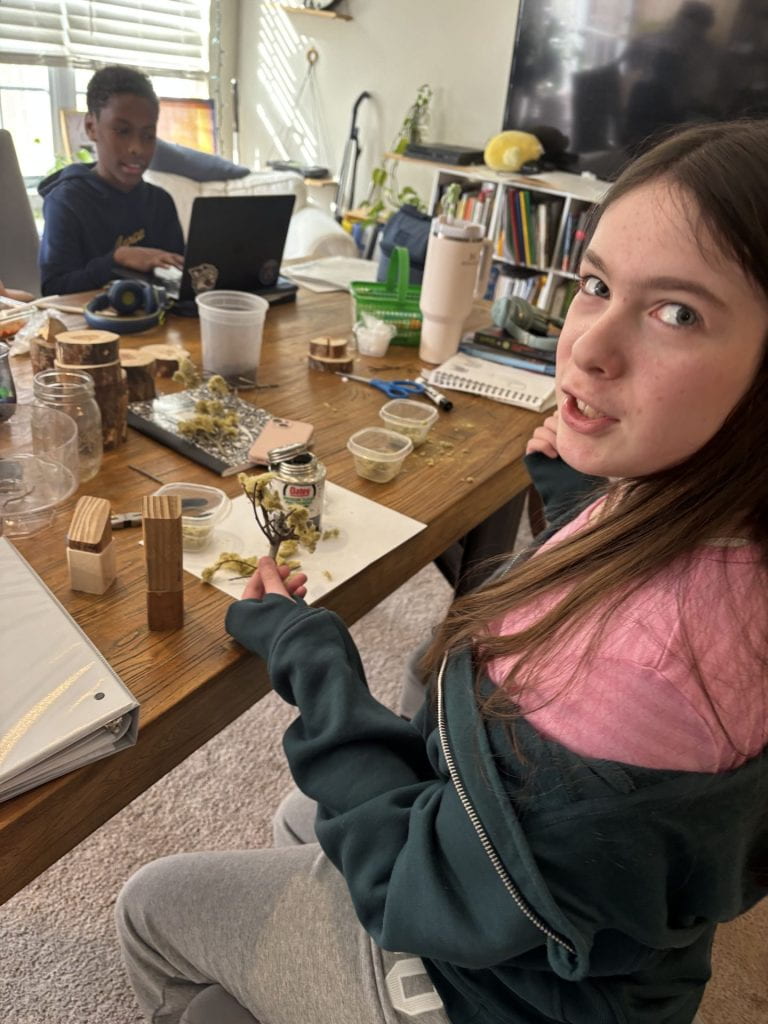
We came up with the layout for our model this week and started to design the buildings and the mountain that are the focal points for our city. Please see our photos below!
The kids also came up some great ideas for our presentation! We watched past Future City Competition Presentations to get a sense for what they are like and I think we’ve got a great one in the works. Ollie, Jaden and Laurence will be our presenters, and Luka has offered to be a backup. We will pretend to introduce Yukiville through 3 characters: An influencer and tourist that comes to see our city, an engineer who headed up the design for our future city, and a local tour guide who will share the perspective of living in Yukiville as a full-time resident. Michelle, Laurence’s mom is a professional presenter and she will come on the 14th to help give us some presenting tips. On the 21st, we will go to The Hurt Hub in Davidson to practice our presentation with Michelle, who will guide us. Many thanks, Michelle, for your support!!! Michelle is the founder of Activate the Awesome located in Davidson, NC.
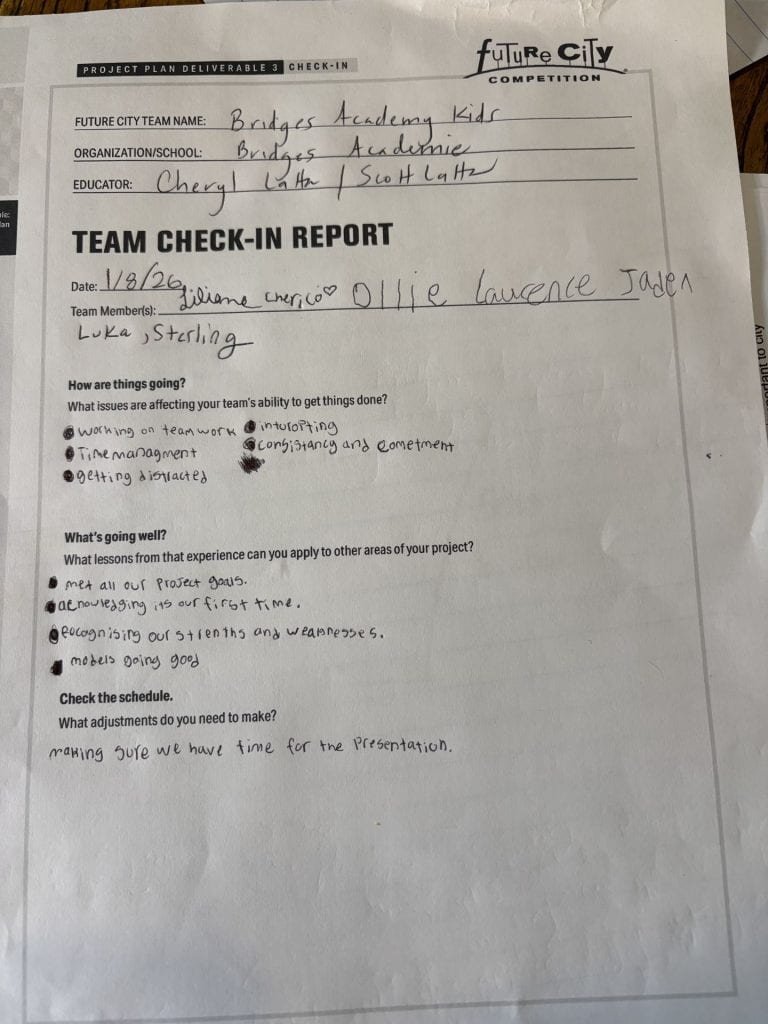
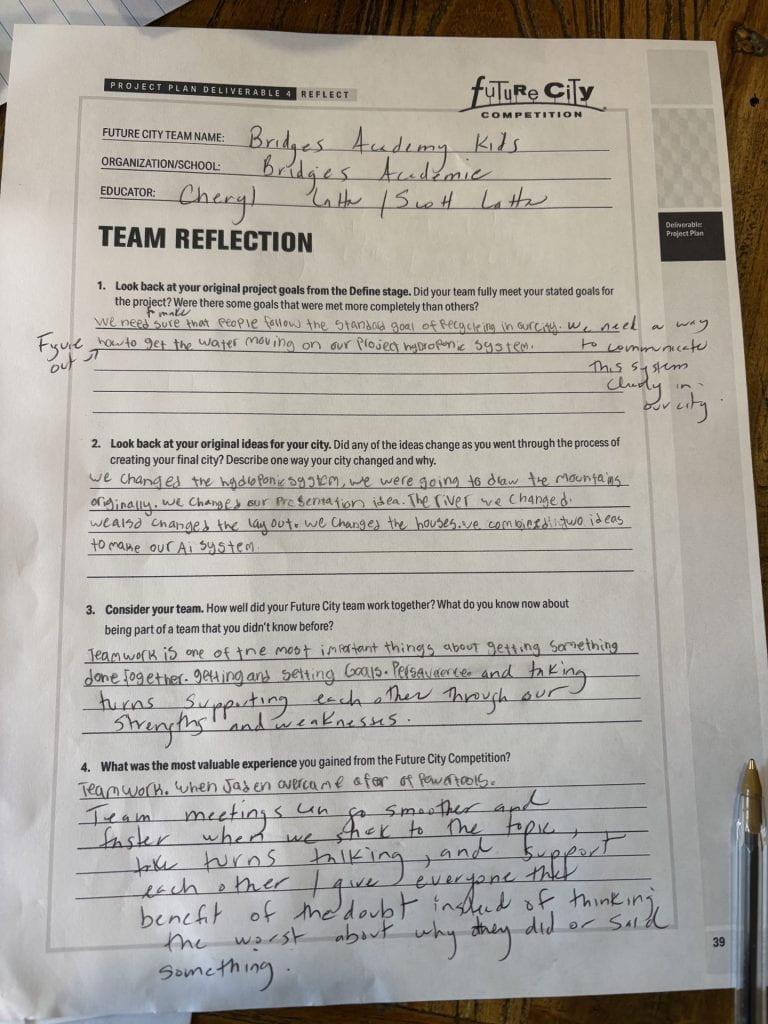
Project parts 3 and 4 were due this week and these required a team meeting to complete. Lili and Jaden were both instrumental at helping us to make so much progress on coming together as a team. Our meetings tend to go long as our ability to communicate effectively is still a work in progress. On our second attempt, Ollie timed us to see if we could stay on topic, not interrupt, imagine the best intentions in one another and work towards synergy of ideas. We went from a first meeting that took way too long to a second meeting that accomplished all of our goals in under 15 minutes. Way to go team!! We made so much progress on our communication and got our project 3 and 4 deliverables in on time.
Reading and Writer’s Workshop
We’ve continued to read our individual reading choices daily during Book Club. We read right after lunch and this has been a favorite time to relax, read and talk about each of the books we are reading. These are some of our best conversations and sharing our books has led to cross overs in what we each read. We balance our reading with IXL goals and reading to research and learn information for our projects. This has been an amazing way to grow each of us as readers as well as strengthen our connections to one another. Scott and I read too and share our books as well as make connections with things the kids are thinking about and exploring. WE love this time too!!
All the kids have selected the stories or writing projects they will share for our next Writer’s Celebration. Some of the kids are working on editing their stories. Scott and I are working alongside them to edit and record the progress they’ve made from the last writer’s celebration, and the areas for growth moving forward. All of their edits are in their record books so we can continue to document progress and set new writing goals over the course of the year. We decided to postpone our Writer’s Celebration until after our Future City Project.
IXL has been a great addition to our ELA program. All the kids took an initial diagnostic and are using their individual Action Plans to move forward with reading, writing, grammar/mechanics and vocabulary goals. I think adding IXL helps to provide balance between choosing their reading and writing selection and targeting areas they may not choose, but will contribute to their overall growth as readers and writers.
Math
All of the kids have finished their first Math Units and are on to the second units. Scott and I are seeing a huge difference in their capacity to use their own individual figuring out process to solve math problems. We are also seeing a sense of ownership in achieving their math goals and patience to maintain focus for increased amounts of time.
Our Future City model relies on using rations and proportions to scale our model effectively to present our city in a way that makes sense. We are all learning about the importance of scaling as we do our model. We kind of took a backwards approach and realized that our houses/hotels were about the initial size of our mountain and then had to go back to the drawing board to fix it. We are all a work in progress and learning to shift when we notice something isn’t working is a great life skill to acquire.
Please continue to support your child learning their math facts at an automatic level. Once kids move into higher levels of math in middle school and beyond, math becomes more complex, and it saves so much time when basic facts don’t add additional time to working through problem solving. It is frustrating, for example, to be faced with a complicated division problem or multi-step word problem and have to count on our fingers to figure out basic facts.
Social Emotional Learning
There are 5 basic competencies that support learning/growth in all areas.
Self-Awareness
Social Awareness
Self-Management
Relationship Skills
Responsible Decision Making
When equipped with these competencies, children are better prepared to socialize productively, improve at resolving conflicts and manage their emotions. Trauma, anxiety and behavioral disorders impact the development of these skills.
When kids don’t feel safe, respected and capable in an environment, they spend more time protecting/defending themselves and less time learning. When negativity is the go to mindset for a child, they struggle to progress.
I have created an inventory and goal sheet to help figure out which are the most important areas to work on for each of the kids and set targeted goals for each of them.
This week, we all worked heavily on effective communication during our team meetings. All of the kids (and most adults) can always continue to grow in this area over a lifetime 🙂
Please mark your calendars – Future City Competition is January 24th. Families are welcome to come up and see the competition too 🙂 Last year, Future City provided a hotel room for schools at a distance away and I’m expecting this year will be the same. The kids would leave Friday night and spend the night to be ready to be at the competition the next morning. More details to come 🙂
Our winter break is scheduled for December 22nd through January 4th. Our last day of school together is December 18th (home learning day on Friday the 19th). We come back to school on Monday January 5th.
Future City Competition
We finished our Future City Essay this week in time for our December 5th deadline and it’s officially submitted! This is the first deliverable for our project. Next week, we submit our project plan and timeline schedule. This has been a great chance for the kids to go through the Engineering Design Process to see how work team’s breakdown long term projects and goals into small, manageable steps. Collaborative teamwork means that we all share our individual strengths and challenge ourselves to come together to create!
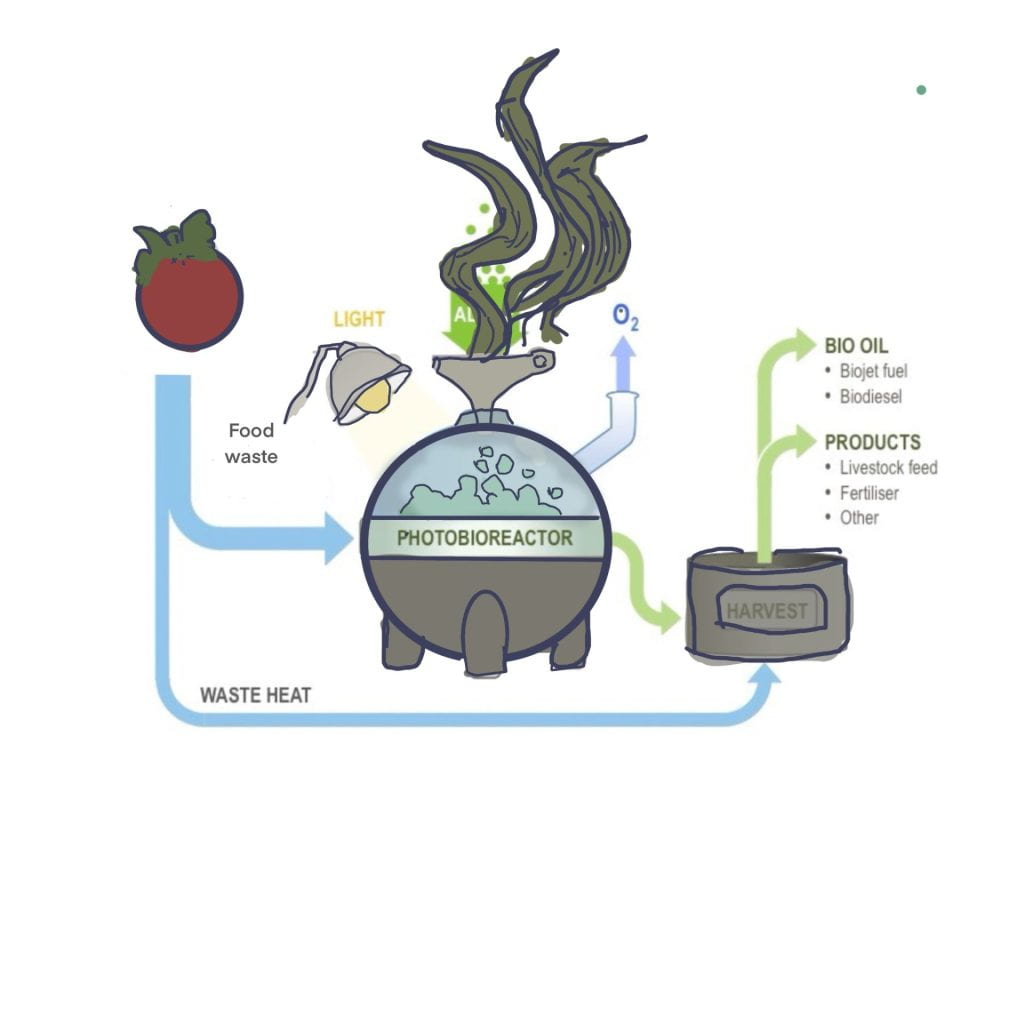
All the kids participated in the research process to arrive at our creation of Yukiville, a city in Japan 100 years in the future. Laurence, Ollie and Jaden worked with Scott to design the graphics that showcase our solutions, while all the kids took a turn writing a paragraph or two to contribute to our essay. Sterling, Lili, Luka and I worked on editing and comparing our essay to the rubric to make sure we had all the required elements while staying in the 1500-word count limit.
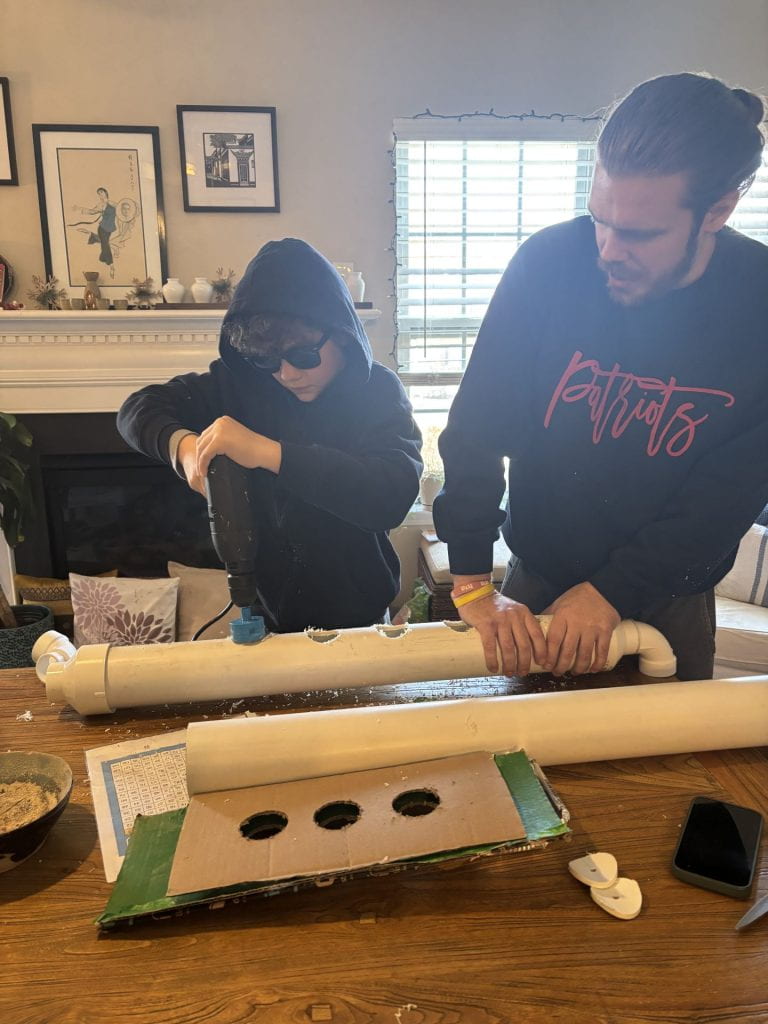
This week we will start work on planning our Future City Model. We are planning to include a working hydroponic garden system in our model with flowing water for our working part and so we’ll begin experimenting with that this week. We are also experimenting with making DIY biodegradable packaging with food starch this week.
Math
We had a great time having a little friendly competition this week to practice math facts using the Fact Freaks Online Game. This game had Scott and I trying to beat our own high scores even after the kids left! This game times how many math facts can be entered correctly in one minute. We all did the Impossible Level where it mixes up addition, subtraction, multiplication and division facts. Scott holds the high adult score at 56 while Laurence leads the kid’s high score with 26. If any of you challenge yourself and get a high score, let us know and we’ll post you on our leaderboard 🙂
All the kids are working on their individual math goals while Scott and I sit alongside them daily to work through their math. They’ve all done an amazing job of rising to the challenges of more complex math and their patience and focus is growing steadily. White boards have been a great way to support writing things down and a great way for Scott and I to solve problems alongside them. I love seeing them regularly challenging themselves to creatively figure out how to solve problems and the different ways each of them approaches it.
Our Future City Project has provided a great opportunity to see the real-world applications for our math skills. Ratios and proportions come to life as we use them to scale our model parts and break down experiments. Measurement proves to be a valuable skill when we read directions and measure out materials for our carbon dioxide experiments and build the platform for our hydroponic model. Visual design and planning the diagrams to explain our food waste solutions has us using spatial awareness and geometry.
Community Building
We’ve continued to build relationships by working on communication skills. Studies say that the communication and conflict resolution skills we build in adolescence are the ones we tend to use over the course of our lives. Think about how you learned to communicate and resolve conflict…most of us learn this at home, at school and in our peer group. Often, these very important skills aren’t taught with intention. We start everyday by reminding ourselves of the skills needed to work together in community.
This week we’ve continued to highlight that true belonging means you don’t have to continuously “one up” and prove yourself worthy…you can relax, be yourself, make mistakes and feel valued and cared for. Alongside this, we talk about what support at school looks like. We don’t need to pile on when someone makes a mistake, we can imagine good intentions, and problem solve by putting relationships first. We can support each other’s focus and our collaborative work together by taking turns when we speak, reflecting on what we say before we say it, and by knowing appropriate time for hard work and having fun. We don’t all have to know everything, and we show our confidence when we are ok with listening and learning when a friend shares something they know that we don’t. We talked about the “6 second rule” as the amount of time our brain needs to switch from an instant reaction to a thought-out response and how we can each find strategies that help us to take space when we need it, so we can respond well and protect our relationships with one another.
Reading/Writer’s Workshop
The kids had a GREAT discussion this week during book club! We each read together daily for 20 minutes and then we share what happened in our books with each other. It is amazing to notice how many connections they make to themselves, each other and to the books they are each reading during these conversations. Often, their sharing leads to one of them choosing to read someone else’s book and so it’s broadened many of their reading choices. Ollie decided to read Sterling’s “The Summer I Turned Pretty” series, Jaden is now reading Laurence’s “Hatchet” series and Luka just finished reading the first in the Hunger Games series that Laurence and Ollie read last year. This week, Lili shared about how dogs entered her Warrior Cat Series story and the kids started a whole discussion on how unexpected moments get introduced into books and then veered into further sharing around why cats have nine lives as they shared individual stories around their own pet experiences. Any of their stories could become books and all of their sharing deepens their relationships with one another.
We took a pause on writing our individual stories so we could concentrate on finishing up our Future City Essay. We will get back to our regular writing next week 🙂
Science and Social Studies
These go hand in hand throughout our Future City Project as we are working on solving a world problem collectively and this often requires experimenting and learning about the science to understand the WHY behind a focus on creating a circular economy and reducing food waste as well as the social aspect of figuring out how/why we need to think globally in terms of a world community when we are creating solutions that effect and impact us all. Why is community important? Why is it valuable to think beyond our own individual lives to consider impacts we all face more broadly? How can we create unity and trust across communities and cultures so we can come together to solve world problems?
We are learning about climate change and how human activity has impacted the balance of Earth’s natural systems. We did science experiments to create carbon dioxide to show the increase in temperatures that occur when increased amount of carbon dioxide and methane gas get trapped in Earth’s atmosphere.
We got the supplies this weekend to create our hydroponic solution for our Future City Model. We are hoping to create a model size hydroponic system as the moving part for our model. We are also doing DIY experiments to make biodegradable packaging using food starch. I’m excited to see the results of this experiment!
Thanksgiving Break this week. We only have school scheduled for Monday (24th) and Tuesday (25th). Wishing everyone has a beautiful Thanksgiving together and we will meet back for school on Monday, December 1st.
Future City Project:
We are following the Engineering Design Cycle to complete our project. The kids have worked with us to use the project deliverables and our school calendar to come up with a plan to complete the different areas of our project by the deadline. Breaking up a big project into manageable goals and assigning different elements to team members, based on our unique skills and strengths, is a lifetime skill that we can apply to any project small or large, now or in the future. Turning in our schedule is the first project deliverable for The Future City Project.
We have been researching to define the problem for this year’s challenge: Build a city at least 100 years in the future with a circular economy that eliminates food waste. We learned that the US wastes 30% – 40% of food from farm to table and how this food waste impacts us locally and globally: some of the food waste gets dumped into landfills and produces methane, a green-house gas that contributes to global warming. We also learned that 50 million people in the US are food insecure and how using all of our available food could eliminate this problem. We learned that we have been focused on a linear, “Make it, Use it, Dispose” economy and we are shifting to a better use of our resources with a circular economy that minimizes waste and reflects the circular economy that already exists in our natural world.
The kids have found a location for our city in the snowy mountains of Japan and named our future city, Yuki Ville (Yuki is snow in Japanese). This week we began writing the first two paragraphs of our Future City Essay that describes our future city, its location, key geographic features, population and the life of the people living there. We are working in teams to do the research and write our paragraphs. Our complete essay is due on December 5th.
We are using City Skyline to simulate the design for our city to see how it works. Is there enough energy for all the people in our city? Does our zoning create a satisfying life for all of the people? Does our tracking system result in minimal waste?
Science:
This week we learned more about greenhouse gas emissions and how these gases contribute to temperature changes on Earth. We did science experiments to produce carbon dioxide to test the temperature differences when the solutions are heated in a container that simulates the green house effect. The kids also had a chance to predict and make a hypothesis about which liquid would have the highest temperature, record lab results and draw conclusions.
Math:
All the kids are working on their individual math units at their own pace. Scott and I support each of them in different ways using methods that seem to work best for each one. Ollie and Lili are both working on division and a combination of repetition and a graphic showing the steps “Divide, Multiply, Subtract, Drop, Repeat” has worked. Jaden and Laurence are working on ratios and proportions and working side by side with each of them to solve problems and compare notes works great for them. Sterling and Luka tend to like to try it out first and then ask for support or an example if it feels confusing. Other times, either of them may enjoy us sitting next to them and working through problems together. All of them are gradually becoming used to their strategies and have identified ways of doing math that work for them. We aim to do 25 IXL minutes of math a day (which is longer than an actual 25 minutes by clock time). They choose their best individual workspace; some like white boards, others paper or writing on the tablet, some break up the time by resting in the middle while others can go the whole time without stopping.
Our Future City Project supports the real-life use of math. For example, ratios and proportions to scale our model, taking and recording temperature, measuring liquids for our science experiments. Quantifying population and measuring out distance for our Future City description essay….
Reading / Writing:
We continued with daily reading of our books of choice and sharing what is happening in our books with one another. The kids have all published their book reviews on their individual blogs. This was a great chance to practice writing to share information. You can see your child’s book review by going directly to their individual blog. Their individual blogs can be found on the same page as this blog. Just look to the right of the main page to see a list of “Student Blogs”. Ask the kids if you need help finding them 🙂
We continued to work on our individual writing projects during daily Writer’s Workshop. As they work on their stories, Scott and I do writer’s conferences to support and grow each writer. Having the chance to choose your writing topic and genre helps each individual to learn more about themselves and their identity as a writer as all of us have our own style, strengths and preferences around how we express ourselves and communicate. I am seeing the kids develop a “writer’s style and voice” as they continue writing. They are also using much more descriptive language, dialogue, richer story lines and more sophisticated vocabulary and grammar to develop their ideas. We will plan our next writer’s celebration to share our newest stories before the next holiday break.
Thank you for adding IXL Language Arts to your child’s account. Just like math, IXL offers a great chance to assess and practice the individual skills each of them may need and presents an easy way to keep track of growth.
Finding resources, researching, pulling out relevant information and using these to create an essay that shares our Future City in an effective way within a 1500-word limit that follows a rubric is a skill all of the kids will be able to use to write to communicate. We are working on our essay in writing teams and this adds the extra element of developing the soft skills needed to collaborate and work effectively on teams.
Social Studies:
One of the first questions that came up as we started the Future City Project was “Why should I care?” One of the kids had the courage to speak up and say, I’m not experiencing food insecurity and I don’t see any signs of a problem with the environment in my life, so why should I care?”. I loved that they said this out loud rather than just feeling it inside and going on with the project just because a teacher said they have to do it.
To respond to this really important question, I shared the idea of “Circle of Concern” with them. All of us are usually pretty consumed with whatever is in our daily lives: our family, friends, routine, work, daily tasks etc.. It is hard for all of us to imagine the experience of someone or something that is outside of our daily realities. It is very hard to give a lot of time and attention to things our brain doesn’t directly connect to as relevant, so how can we broaden our circles of concern and why should we?
Lili’s mom visiting for Veteran’s Day provided the perfect chance to address these questions. Lili’s family is a military family and so Veteran’s Day, the health, welfare and treatment of Veterans’ and the individual stories of Veterans are in their immediate circle of concern. Lili’s mom’s daily life includes the health and wellness complications of having experienced the burn pits and life in a combat zone. When we all heard Angela’s story and learned more about the burn pits through the Kevin Lloyd Project, we could connect to the experience of Veterans in a whole new way. The term “burn pits” took on real meaning for us and we will never hear that word again without feeling something about this issue. This is how we broaden our Circle of Concern; we step outside our own daily experience and connect with others to learn about theirs, so we feel more connection and community with others.
Social Emotional Skills
We use the daily happenings in and out of school as a platform to talk about and teach the skills that all the kids need to effectively communicate and feel belonging in relationship with others. Our aim is to create a stronger feeling of collaboration and community so that everyone feels celebrated and respected for their individual strengths and ways of being while balancing these with a world view that extends to seeing the world in an interconnected way. How do my choices and actions impact myself and others? How do I choose my response? Does my choice reflect just watching out for me or does my choice extend to contributing towards a healthier, safer community that allows all of us to work together effectively?
The kids take turns showing growth and making mistakes on this as a normal part of learning. It is easy to notice something that offended or felt great to you, but it is also necessary to be able to see outside of your own experience to see others.
To that end, we have worked on:
What is a joke? (we hear “it was just a joke” a lot and often what one person sees as a joke constitutes hurt for someone else.)
Conflict Resolution: What’s the best way to address a problem with a friend? Teaming up, piling on, seeing the story from only your own point of view, reacting rather than responding are all things we regularly see. We teach: talking/listening to understand different perspectives, getting the facts on the whole story before assuming the worst in someone, talking one to one to resolve a problem rather than getting validation of your point of view in a group or teaming up against one person to argue for your “rightness”. etc.
We teach that the goal of conflict resolution is relationship not proving your rightness.
All of the kids make mistakes and all of the kids hurt one another from time to time. Hopefully, with more support and practice …the kids will have the skills they need to contribute to connection and community in our world rather than divisiveness so we can collectively enjoy each other, solve problems in our world together and create!
We are scheduled to be in school on November 11th for Veteran’s Day. I tried to consolidate all of our breaks so that we’d maximize the continuous learning time together in school, balanced with concentrated family time for rest and connection. Please know that important commemorative holidays are deeply honoredand respected and we spend time learning about each one. As always, families have flexibility to approach these decisions in a way that feels best for your child and family. If your family has an alternative plan for honoring any holiday, please know that this can take the place of a day in school together with us.
Our Thanksgiving break, is scheduled for Wednesday 11/26 -11/29. We are back to school together on Monday, December 1st.
IXL has an English/Language Arts strand in addition to the Math strand. It is $5.95 a month to add this function. I think this would be a good addition for the kids to have. I am keeping track of their grammar/spelling/writing/reading progress and teaching to the particular skills each of them need, but adding a session of IXL ELA practice to our learning schedule, especially as a part of Friday home learning, would allow each of them to have some repetitive practice with using the skills they learn here as well as provide a diagnostic to show growth over time. If you’d like to consider adding this feature, you can go on to your child’s account and add it. Please let me know if you choose to add this feature.
Future City Project:
This week, we kicked off the project with a field trip to “The Innovation Barn” in Charlotte. Here the kids had an opportunity to explore Charlotte’s progress as we work towards creating solutions that move us from a linear economy to a circular economy.
This week, we rooted our learning in the Life Cycle of a Tree, exploring nature as the original model for a circular economy.
We investigated why leaves change color and fall, noticing how this natural process ensures nothing is wasted—the falling leaves become vital resources (nutrients and energy) for the next stage of growth.
By mapping the tree’s complete life cycle, the kids recognized that everything in nature operates with purpose, demonstrating perfect resource efficiency. We then brainstormed other natural cycles to reinforce this pattern of continuous use and regeneration.
This led to an important question: How does the human linear ‘take, make, waste’ economy compare to nature’s circular model? This week we will explore the impact of this linear approach and the need for a shift to circular thinking.
We are using the engineering design process to research the problem, identifying a location for our future city, and make a plan for our zero-waste farm to table city. Our essay, which outlines our plan is the first deliverable and it is due by December 5th. We will also have to submit our project plan to show our project goals, timelines and schedule by December 5th.
Community Project – Social Emotional Skills:
We use the real-life things that happen in our learning community as a jumping off point for learning the skills, tools and mindsets that are needed to make a shift towards working together and sharing power in a more collaborative community. This is a shift from the competitive hierarchy of popular kid culture that is still present in many schools and so it takes time and effort to get buy in from the kids as we highlight why this is important and teach the skills that make it a reality.
This commitment to shared leadership and resourcefulness is the core mindset required for the circular economy and global collaboration we are working towards in our Future City Project.
All the kids experience friendship issues with one another, in and outside of school, with friends that include and go beyond our learning group and so these become great opportunities to teach using concerns that are relevant to the daily lives of the kids.
We spent time this week diving into some of the essential skills for healthy friendship and conflict resolution: Self-awareness, balance of give/take, listening, investing balanced effort, and honesty.
We did an exercise together: The kids each anonymously listed the things they look for in a good friend, and we put them in one basket and then they listed things that indicate someone is not a good friend and put them in another basket. It was interesting for them to notice that they all seem to want the same things and all feel hurt by similar things in friendships. We talked about the idea that we can often point out the things we don’t like that others do, but it is harder to notice when we do similar things to others. Self-awareness and awareness in general are an important part of friendship.
We watched clips from “Wonder” to help the kids visualize what a healthy friendship looks like. The Wonder clip led to some great discussion on the challenges and the courage it takes to stand up for what you believe is right by making the choice to practice the skills of being a good friend.
We regularly spend time working through conflicts with the kids so they can practice the skills of good friendship and conflict resolution. Research says that the skills kids learn in adolescence around relationship skills are often the ones they use and carry on with throughout their lives.
Science:
The kids had a chance to gather leaves and do Leaf Chromatography Experiments to find out more about the purpose of the different colors in leaves and why we see green in the spring and summer and a shift to yellow, orange, purple and red in the fall.
We looked at how chromatography is used as part of the FDA testing to find out what dyes/chemicals are present in our food.
Book Club/Writer’s Workshop:
Lili, Ollie, Laurence, and Sterling finished reading their books this week and each of them made a new book choice. Ollie is reading an Agatha Christie mystery, Sterling is reading the second book in her “Summer I Turned Pretty” series, Laurence will move on to book two of the “Hatchet” series and Lili will do the same with her Warrior book series. Jaden and Luka are still in progress with their books.
The kids each wrote a book review for the book they are reading using a format I shared with them which includes a book summary, a favorite part in the book, and two strong reasons why they’d recommend their book to others. Their book reviews will be posted on their digital portfolio under the “Books I’m Reading” Category.
All the kids are still in progress with writing their newest creations. Ollie is writing a pilot guide, Laurence is writing a realistic horror fiction story surrounding a mysterious piano, Sterling is writing a story set in a school with a new cast of characters involved in their daily work of friendship and mystery, Luka is writing a story set at a beach with half human/half animal characters, Jaden is working on a horror story featuring GOAT Pizza as the setting for his story while Lili is busy creating a new story that features her favorite cat characters in a new setting.
The kids all finished sharing their Ancient Civilization Power Points this week, with the exception of Laurence who will share this coming week. These social studies projects gave them an opportunity to practice presenting, researching/sharing information in their own words, and creating engaging work that keeps the interests of their audience in mind.
Math:
All the kids are making steady progress with their math units. The goal is for them to each finish two math units before our December break and then do the final three in the second half of the school year.
Scott is now fully engaged with working one on one with the kids in math alongside me and so all of the kids are having even more one on one time to work through their math skills with support.
The Future City Project, our recent science experiments and even their passion projects have given them lots of opportunities to notice how they use and apply their math skills in their everyday life.
We will begin our Future City Project officially this week with a field trip on Tuesday to The Innovation Barn. See more about the Future City Project below.
One important date: January 24th is the Future City Competition at NC State. Last year, Future City paid for a hotel for schools that are a distance away, and this is my expectation for this year. Parents are invited to come to the competition as well and can reserve a hotel room. I will send information as I receive it.
Digital Portfolios – The kids have their digital portfolios set up and they are starting to add to them regularly. When I post the weekly blog, you can see the kids’ blogs on the same page (on the right-hand side). They are visible on a computer, not on a phone. For kids that were at Bridges Academy last year, I loaded all of their posts from last school year on the “2024-2025 Last Year’s Posts” category, so all their work is still viewable.
Future City Project
The Future City Project is hosted by NC State every year as a way to offer kids the opportunity to work on an authentic project that transforms their understanding of engineering and strengthens their teamwork, problem-solving, and project management skills. The theme for this year’s project is to create a city with a circular economy where farm to table, there is zero waste. The kids will learn about our current linear economy and how the waste we produce from a “throw away” economy currently impacts us. We will learn about lots of the possibilities for new ways of growing localized food that uses less water, sunlight and space. They will also learn about how waste can be repurposed, so we move towards zero waste. As part of the project, the kids write an essay explaining their proposed city, create a model to scale of the city, attend the competition at NC State where they present their model to a panel of engineers and have the opportunity to see the many models created by the 160 different schools that attend the competition.
Here is a link to a video that shows what The Future City Competition is like.
Here is the webinar for educators, mentors and parents who want to learn more about this year’s Farm to Table Theme and the circular economy of zero waste that we are working towards.
Community Project
Our community project threads through our whole school year as we continuously work to create a culture where everyone is valued and supported, where mistakes are seen as part of the learning process and we realize that each of our unique identities contribute a piece to our greater whole. We regularly revisit our shared learning contract and spend time building relationship and learning the skills that help us to be effective in our relationships with one another so we can live up to the agreement we made in our shared contract.
We have been exploring ancient civilizations to see how their communities functioned. Each of the kids researched a different civilization and created a presentation to share with their classmates. I modeled this process when I shared Ancient Mesopotamia with them, and they are using the same 7 Features of Civilizations to research and share their civilizations. Jaden and Ollie have already presented, and the rest of the kids will share in the coming weeks.
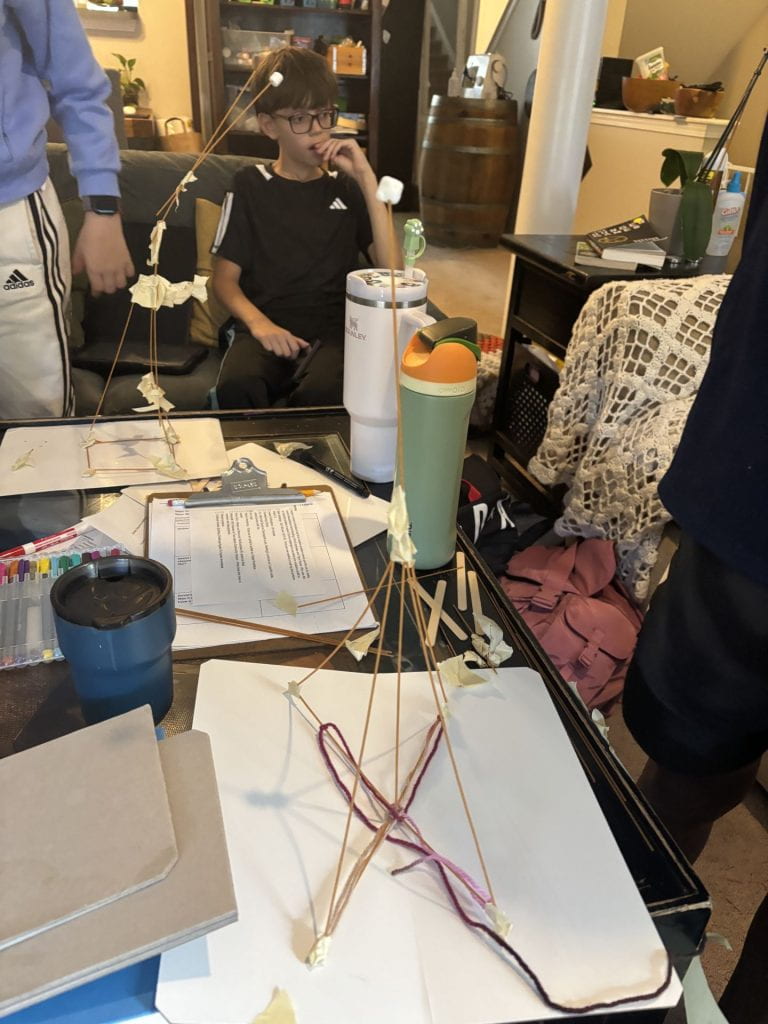
We kicked off our preparation for the Future City Project by tackling “The Marshmallow Challenge.”
The goal was to intentionally practice essential collaboration skills. In a world that often emphasizes individual competition, the soft skills needed for effective group work—like giving constructive feedback, managing diverse ideas, and sharing leadership—need to be directly taught. By building a shared understanding of how we collaborate before we start the heavy learning and building of the Future City Project, we ensure thatour learning time is spent on the project content, not on procedural friction. This makes our group work more efficient and ultimately more successful.
Halloween Games and Our Bike Ride to a Local Cafe
Relationship building is an important part of our learning process. When kids feel seen, valued and safe, they can focus on learning knowing that they are part of a collective circle of trust and caring.
Just before the Fall Break, the kids brought their bikes to school to do a fall ride through our nearby Greenway to a local cafe where we did our book club and writer’s workshop work.
🎃 We kicked off the post-break session with some spooky fun, hosting our own Halloween-themed “Minute to Win It” games! The goal was pure, supportive connection. Rather than focusing on competition, it was designed to create non-stop opportunities to cheer each other on, celebrate silly mistakes, and prioritize fun over perfection. It was a great reminder that our greatest strength is the joy we find in supporting one another.
Science
Collective Inquiry: The Power of Shared Knowledge
Just before the break, did an exercise designed to highlight the learning process itself. I asked everyone to contribute everything they knew about why leaves change color onto a shared whiteboard.
The purpose of this activity was to shift the focus from individual performance to collective synthesis. We stressed the following key principles:
Individual knowledge is a starting point, not the end goal. Knowing all the answers isn’t important; what matters is what we do with the knowledge we have.
Synthesis builds greater understanding. By sharing and pooling our different facts and ideas, we constructed a richer, more complete picture than any single person held alone.
We connected this directly to the scientific method, emphasizing that this is precisely how real-world scientists work: they build upon shared knowledge, identify gaps, and use collective data to ask new, important questions that lead to breakthrough discoveries. This process of collaborative inquiry is the foundation for our upcoming learning, ensuring we focus on building knowledge together. This will be useful for our Future City Project learning ahead.
This coming week, we will do some experiments to find out more about how and why fall leaves change color.
Math/Reading/Writing
All these continued as usual. The kids are all working on their math goals using the individual plan set for their learning needs. Scott and I sit with them and work together to complete math goals with a focus on math as a language and problem-solving process that we use every day.
The kids are continuing to read every day during book club. We share summaries of what we read, examples of how the author develops the characters in our books and more! The idea is for us to read like writers and use the techniques we notice authors using in our own writing.
Writer’s Workshop happens every day. The kids are writing their own creative pieces in a genre of choice. We also write and share other forms of writing through our academic content areas. For example, right now the kids are writing presentations to share about their ancient civilizations. They also shared their knowledge about why leaves change colors in writing this week.
I noticed the spelling and grammar mistakes they were each commonly making in their writing and we are practicing some of these skills each week: Their/there and they’re, too/to/two, capitalizing proper nouns, how to punctuate quotes etc.
Fall break coming up on October 22nd -October 29th 🙂 We come back to school on October 30th.
I signed us up for The Future City Competition held at NC State University in January again this year. We will begin this project at the end of October and continue until the competition date in January. Every year the competition focuses on a world problem and the kids create a model of a city that incorporates their solution to the problem. This year we are focused on designing a city that eliminates food waste from farm to table and keeps citizens healthy and safe. I am looking for opportunities for the kids to explore our community to find out more about the efforts we are already making as well as the proposed ideas. Ollie’s mom and I talked about Davidson College and making a visit to see Davidson Farm and their sustainability efforts. She is also checking into visiting the student cafeterias at Davidson College to see how they manage food waste. The town of Davidson also provides options for composting etc. so we will explore these too. If you know of any other contacts or places to visit to further our understanding of food sustainability and food waste, please let me know 🙂
If you haven’t had a chance to connect with me to chat about the SMART learning goals we’ve set or what I’m seeing so far this year with your child’s progress, please feel free to set up a time to chat with me.
Our Community Project – Incorporates all the academic areas below. Please see what we are up to 🙂
Social Studies
I finished up teaching about Ancient Mesopotamia this week. We are working our way from hunter gatherer, ancient civilizations, industrial revolution and modern cities to explore how our sense of connection in community has changed over time. The kids each picked their own ancient civilization to research, explore and share their learning with everyone. We are busy doing the research now. Ollie is exploring Ancient China, Laurence – Ancient Japan, Luka – Ancient India, Jaden – Ancient Rome, Sterling – Ancient Greece and Lili = Ancient Egypt.
The kids had a chance to try writing in Cuneiform (Writing style of Ancient Mesopotamia). We did some decoding using the language similar to the way archaeologists who found the ancient language had to do to discover the stories and culture of Ancient Mesopotamia.
We listened to oldest story in the world “The Tales of Gilgamesh” from Ancient Mesopotamia and talked about how we know if someone is a good leader and what a person has to learn before they can be a good leader. The kids’ responses to these questions were insightful! See their thoughts in the photo gallery below.
We resumed our role of being lawyers by looking at Hammurabi’s Code and coming up with what we each thought were fair and just consequences to the misdoings of the people of Ancient Mesopotamia. As the Code of Hammurabi is based on the idea of eye for an eye justice and there were different consequences depending on one’s place in the social hierarchy, the kids quickly came to the conclusion that this first legal code had flaws in its harshness and lack of fairness.
We compared the fairness of our Bridges Academy code to Hammurabi’s Code and decided ours was a way to create a supportive community that created opportunities for everyone to thrive.
We have been working on practicing “flexible thinking” and using multiple perspectives to explore the situations we face in our group and through our explorations of current events in our community. For example, when we have a conflict in our community – we explore how different people may view the same event from their own perspective and how understanding this can help us to come up with win/win solutions that take everyone into account thereby strengthening our relationships and connections. We also talked about this several times in relation to world events.
Math
The most interesting development in math this week is the recognition that everyone approaches math differently. There is not just one way to solve a math problem (or most any problem). Math is not just a step-by-step process that can be taught and repeated; it is a language that requires critical thinking, figuring out and problem solving to make sense of a problem and arrive at solutions. Just as we have our own identity as readers and writers, we also have our own unique identity with math. Jaden’s arrival brought this conversation into being as one of the things that frustrated him most about math at his old school was the fact that he had to follow the process his teacher set for solving math problems, if he wanted to receive credit/grades for his work. After a conversation with him, we worked together to find a way to use his brilliant math mind to solve problems in his own way while I sit with him and solve it too and then compare notes.
The kids will all take a diagnostic coming up this week (with the exception of Jaden, who took one last week). This will update their progress so they can see the growth they’ve come to in finishing up their first math unit. There are five units in all, over the course of this school year. We will periodically take diagnostics throughout the year. Parents can see math progress by going onto your child’s account and viewing the “Analytics” and “Diagnostic” progress on the IXL account. Your kids know how to do this so, just ask them and they can show you how 🙂
Writing Workshop/Reading
Our Writer’s Celebration was sooo great this week! I went to bed so happy on Thursday night !! We had a fair few conversations as we planned the celebration and the kids initially had lots of concerns around sharing something as personal as their own writing with everyone. They worried about reading out loud and having an audience of parents. We landed on making a presentation for parents and reading aloud at home while sharing our stories with each other at school. The culture of community and safety we’ve created was so evident as all of them shared by reading out loud and they were so supportive of each other. The kids felt comfortable sharing what they needed to feel safe while reading and everyone responded with care. One needed everyone not to look at her while she read. Another needed help making the voices in their story come alive, so the kids took turns helping with the reading. Lots of clapping and kind words, compliments and genuine feeling of how amazing each of their creative writing hopefully inspired confidence and excitement to keep writing!
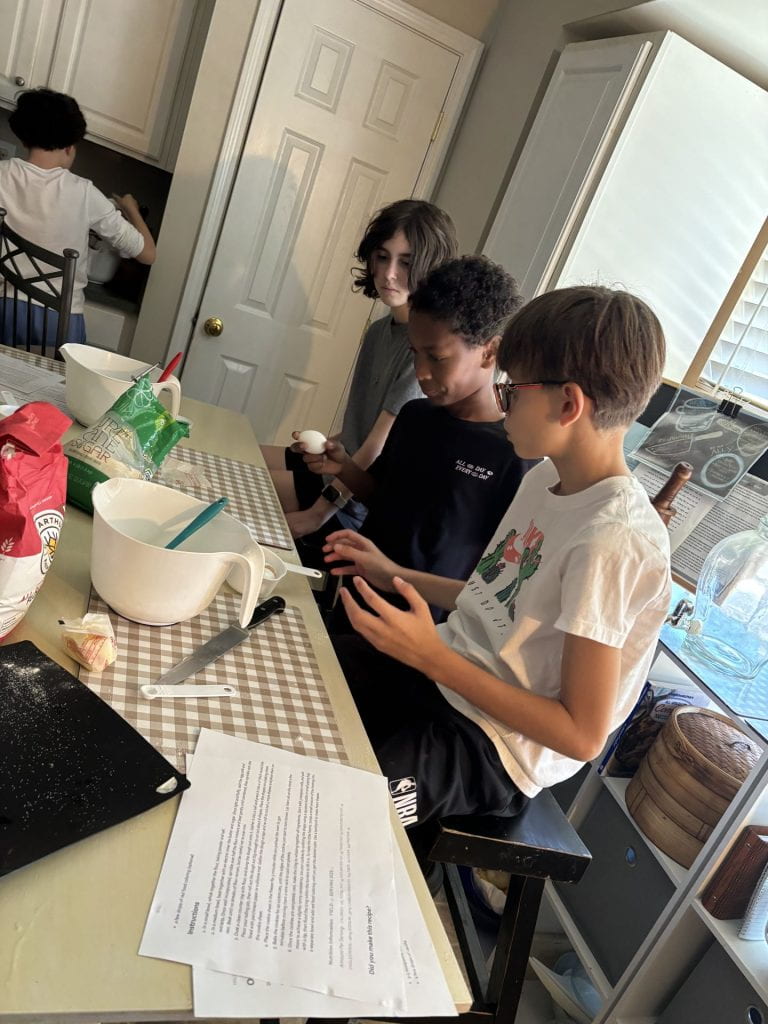
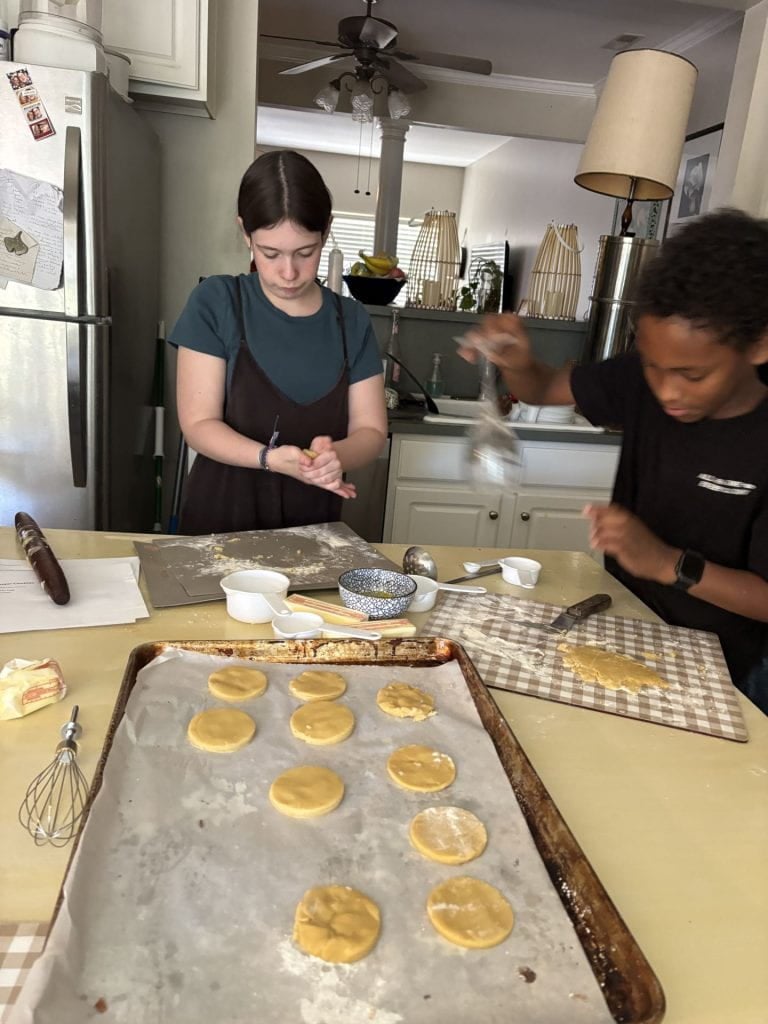
We made homemade cut out cookies and lemonade to celebrate after our reading. We will have many more writer’s celebrations, in different forms, over the course of our school year together.
This week we continued reading our individual books every day during book club. We are still working on writing and sharing book summaries and also finding examples of show/not tell so we can use these in our writing. We are reading like writers and thinking about the great ways the authors we are reading use techniques that make their writing exciting for readers.
Science
We summarized our learning about the value of insects in our world by watching a video that shared what would happen if insects were no longer part of our ecosystem. The kids predicted what might happen before we watched the video, based on the research they’d done. Exciting to note that they internalized their learning and so were able to predict most of the consequences.
Jaden and his family (Megan & Robert) will join Bridges Academy starting this coming Monday. Jaden and family came to our Back to School Night in August and so many of you already got to meet them. Jaden is a 6th grader. I will add them to our family chat this weekend. Please join me in welcoming them:)
Some of you have already reached out for a time to meet, but posting again for those who may want to meet, but haven’t yet had a chance to connect with me. I was able to meet with each of the kids individually to help them set a SMART learning goal. I’d love to share their goal with each of you and give you a sense of what I’m seeing so far with their learning. We could meet by Zoom call if that works or together in person. Please just text me, when you know what will work for you. Afternoons after the kids leave work for me or Fridays are great too.
Lydia is joining us again on Wednesday after lunch to share some games and fun learning around how we build the skill of choosing our response rather than simply sharing our automatic reaction. We learned about the “6 Second Pause” strategy as well as the THINK TEST and how a short pause can create awareness of how we are feeling and allow us to reflect on how we want to respond. The goal is to gradually increase self-awareness and self-control so we can communicate our thoughts and feelings effectively.
FUTURE CITY PROJECT – This week, I signed Bridges Academy up for The Future City Project. We begin the learning, researching to understand the problem part of the project late in October and the competition is in January. This is a STEM project hosted by NC State University every year for middle school students. Every year the competition takes a world issue and poses it to kids to engineer a solution and make a scaled model to share their ideas. It is a big project that includes an essay, building a model, presenting the model to judges at the competition and research/project planning steps along the way. This year the theme is “Design a city that eliminates food waste from farm to table and keeps your citizens healthy and safe. We participated in the competition last year and found it to be an amazing opportunity for the kids to use their learning in a way that impacts the community around them. We will need an engineer mentor if anyone knows someone who would be willing to serve in this role for us, please let me know.
Community Project
We are studying the change in community from hunter gatherer groups to the formation of civilizations to notice what changes about the nature of community when populations increase, social hierarchies form, and complexity of life leads to differing life experiences among groups of people.
We are reflecting what we learn by building effective relationships in our own learning community. Trust and a consistent culture of care/concern is essential to feeling safe in any community and so I focus on supporting the kids in building this culture within our group. Flexible thinking, viewing things from multiple perspectives, communicating in a relationship building way that honors the value of each person are all community building skills that are at times, counter to what they’ve learned in school with peers and what they see in the culture of adults, social media, politics etc., so sometimes it is an unlearning and relearning process once the kids are aware of the value of an effective and supportive community. Learning, creativity and leadership explodes when each person feels a sense of their own value, and in turn is trusting, supportive and collaborative with those around them.
Science
After choosing an “unloved insect or animal” to research, we simulated a court case to advocate for the value and purpose of each insect or animal. The kids researched both sides of the argument for keeping or eliminating their chosen annoying insect or animal. All the kids took turns being the lawyer making their case, the jury objecting or asking for more evidence, the judge or the bug/animal in question. This presented a great chance to realize that everything here on Earth is uniquely purposed to serve a role in our ecosystem. It was also an amazing opportunity to practice flexible thinking, seeing multiple viewpoints, critical thinking and doing in depth research that allows for a fact-based sharing of evidence to back up opinions/thinking. I will share the video clips of the court case in our family chat.
We also took long walks during lunch on the Greenway this week to collect natural materials, and I set up a station where the kids could create with the materials we collected. Taking the time to slow down, notice and see what is all around us in our natural world …sticks, little rocks, acorns, bark, pinecones and more, hopefully will help the kids to broaden their thinking on the value of what is all around them and use it to create. Sterling made a birdhouse, and Laurence is working on a stick being…. hopefully all of the kids will find their way to this create area to make something.
Social Studies
We learned about the 8 Features of Civilizations this week so we could begin to understand the changes life went through as people began to settle down and create civilizations around water access areas. Big cities, specialized labor roles, written languages, belief systems, public work projects like roads, inventions to solve problems, unique art/architecture, social structures, laws and government are all rooted in ancient civilizations. We played Kahoot to review what we learned.
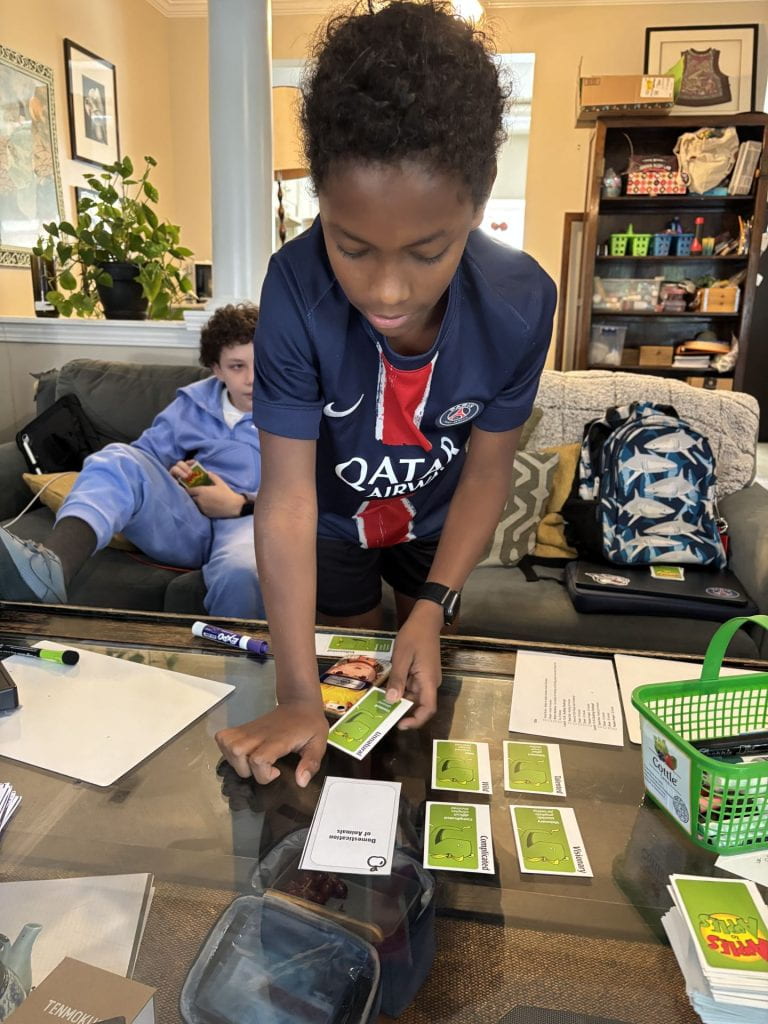
We played an “Ancient Inventions Apples to Apples Game” to learn about where many of the things we use commonly today came from: Seasonings, toothpaste, concrete….many things were invented during ancient times.
I shared the growth of Ancient Mesopotamia with them, and we learned about the language, religions/belief systems, etc about this civilization. I will continue to share more about Mesopotamia next week and offer chances to try writing in Cuneiform, make unleavened bread and think about the fairness of Hammurabi’s Code. We filled out and shared a research sheet with one another so they could practice how to gather information about a civilization. In the coming week, they will have a chance to choose the ancient civilization they each want to research and share.
Math
Nearly everyone is finishing up their first unit of math. Luka, Laurence and Sterling will soon move on to their second math unit on Number Systems which involves using multiplication, division, subtraction and addition in more complex ways with decimals, fractions and integers. Luka will be engaging in their unit from a 7th grade level, while Sterling and Laurence use 6th grade level skills in a similar math area. Ollie is already onto his second unit of math and we are working on using decimals to add, subtract, multiply and divide numbers while Lili is working through the diagnostic skills set by her IXL plan. Jaden will take his diagnostic this week and he may choose to continue the surface area work he was already focusing on previously. It has worked so well to have the kids stay on video chat to work with me on math individually on Fridays.
Reading/Writing Workshop
All the kids finished their stories this week and made their title pages. We printed everyone’s story and did some final editing. Some of the kids are writing chapter books and so have completed the first few chapters while others wrote a series of short stories. The plan is to make a video of the kids narrating their stories to share with all of you. Some of the kids are comfortable reading aloud to an audience while others are not, so we are still figuring out a best way to celebrate our writing. I suggested we make Fall Cookies and Cider and share our spooky stories. If we land on the video presentation, I will share it with all of you so you can see/hear their stories too!
Reading – We read every day collectively as a group using our own chosen book and many days we share summaries of what we read with one another as a group. This has resulted in the kids being exposed to one another’s books. Hopefully, this will lead to a each of them reading a wider variety of books. After hearing about Lili’s Warrior Cat Series, Ollie sought out a copy of this book for his own reading. I am hoping this trend will continue 🙂
Social/Emotional Skills
We hear a lot about the importance of socialization at school and many think of this just as having the opportunity to “make friends”. In reality, socialization in school is SO much more and often our kids learn ways of socializing that we wish they wouldn’t have. It is important to create awareness around what the goal of socialization is – What culture are we trying to create with our kids at school and how does this reflect in the skills we hope kids will develop to move our communities and global world forward? Bridges Academy is focused on teaching the SEL skills that will help kids to feel inner strength and value within them as well as the skills that help them to create supportive and collaborative relationships with each other. All of the skills you see mentioned throughout the learning blog each week reflect the skills kids will need to become informed, responsible community members who are able to communicate their own needs and value as well as connect to the broader needs of the community around them including awareness to their natural world and the role it plays to keep us all moving forward in an interconnected, interdependent world.
These skills are embedded in the activities we do as well as the natural moments that happen all the time as we work together in community. Since we are a small group, the culture we are creating is visible to everyone and we stop and take time to talk about the choices we make and set goals for trying out better strategies so we can increase our capacity to work together well. We notice what didn’t work and do “re-dos” as well as have conversations that repair relationships when we make mistakes.
Lili will begin joining us full time starting next week. Scott will be with us full-time on Mondays and part-time on Thursdays.
Goal setting went well last week. I was able to meet with each of the kids individually to help them set a SMART learning goal. I’d love to share their goal with each of you and give you a sense of what I’m seeing so far with their learning. We could meet by Zoom call if that works or together in person. Please just text me, when you know what will work for you. Afternoons after the kids leave work for me or Fridays are great too.
Community Project
We are working though our Community Project in three key areas:
Creating our own strong learning community with each other using the skills and tools we are learning that support our efforts to build a high functioning community that is rooted in safety, support, encourages growth, creativity and leadership.
Social Studies – We are learning that achieving “success” means more than ensuring financial success for any one individual. Success includes learning how to be a strong partner in all of our relationships with others, strengthening skills/passions so we can express our unique gifts to serve our own needs and the needs of our world, and building knowledge about our world so we can make informed/powerful choices to impact it in a way that brings a sustained future for our world and everyone in it.
Science – We are focusing on learning about the value of our natural world. It is hard to value and protect what we don’t connect to, understand and appreciate. It is also challenging to make powerful choices to protect our ecosystems when we don’t understand the roles of everything in our natural world.
Science –
This week, we finished up our study of understanding social as compared to solitary animals and began thinking about the roles of some of the most irritating insects in our everyday world to find their purpose and value. Next week, each of the kids will act as a spokesperson for an unloved insect to make the case for its continued existence. Laurence is sharing about cockroaches, Ollie is covering mosquitos, Luka flies and I am sharing about wasps. Sterling was sick last week, so we will catch her up when she returns on Monday.
Social Studies –
This week, we began “The Great Disconnection: A Team History Investigation”. Our mission as a team of five history detectives is to uncover how communities have changed over time and to determine the impact of these changes on how people live, work and connect. Each of the kids will investigate a different historical era and then combine our findings to create a single, powerful timeline that presents our evidence to solve the case. We watched “History of the World in 2 Minutes” last week to introduce this mission and begin to get a broad sense of how the world has developed and changed over time. We also began to take a look at our first Hunter Gatherer Communities and the advantages/disadvantages of this kind of simple, direct contact to survival lifestyle that is still practiced today.
Math –
All the kids are doing a great job in working through their individual math learning plans according to their grade level and individual needs. I work one on one with them and Scott does as well when he is here. Research shows that one of the most effective ways to attain a skill or catch up on learning math or reading/writing skills is to have individual support that connects with each person’s unique approaches, challenges or understanding of any academic areas connected with a group of people to share broader connections, different life experiences and ways of seeing. We have the best of both in our small learning group 🙂
Social/Emotional Learning –
We learned how to set SMART Goals (specific, measurable, achievable, realistic and timely) and break up larger goals into mini goals so we can start wherever we are and move towards growth. Setting goals is a way to make learning purposeful and to provide a bigger reason for doing something. It is a way to move beyond instant gratification and in the moment frustrations towards attaining the self-discipline and bigger picture thinking that allows us to accomplish long term goals. Paired with our strengths and passions, this allows us to express our unique purpose, gifts and talents in the world through our own empowered leadership. It gives “school” an intrinsic purpose rather than it being an extrinsic measure of worth.
We are continuing to build our communication skills. The kids are really growing in their capacity to listen to one another during group discussions as well as imagine their audience when they are the speaker so they can choose what they say, how long they speak for etc. with thought for how what they say will be received and understood by their listeners. We are doing games to practice this as well as discussions as part of our learning during our book club book sharing, social studies bug advocate presentations, and sharing knowledge during our history and science projects.
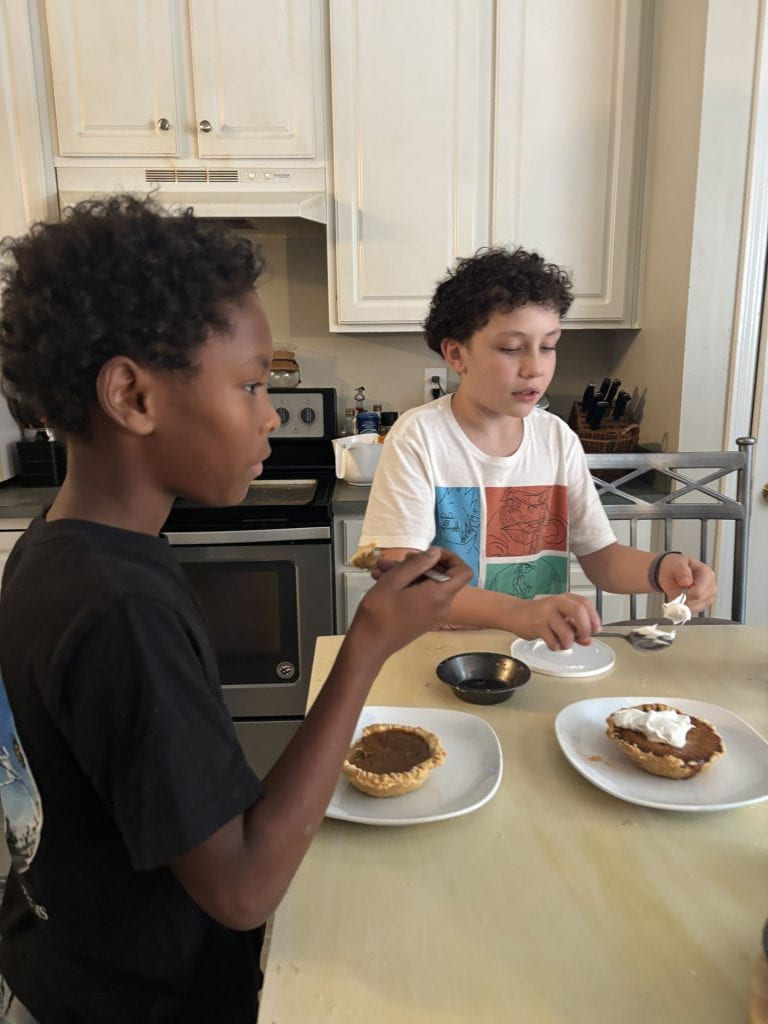
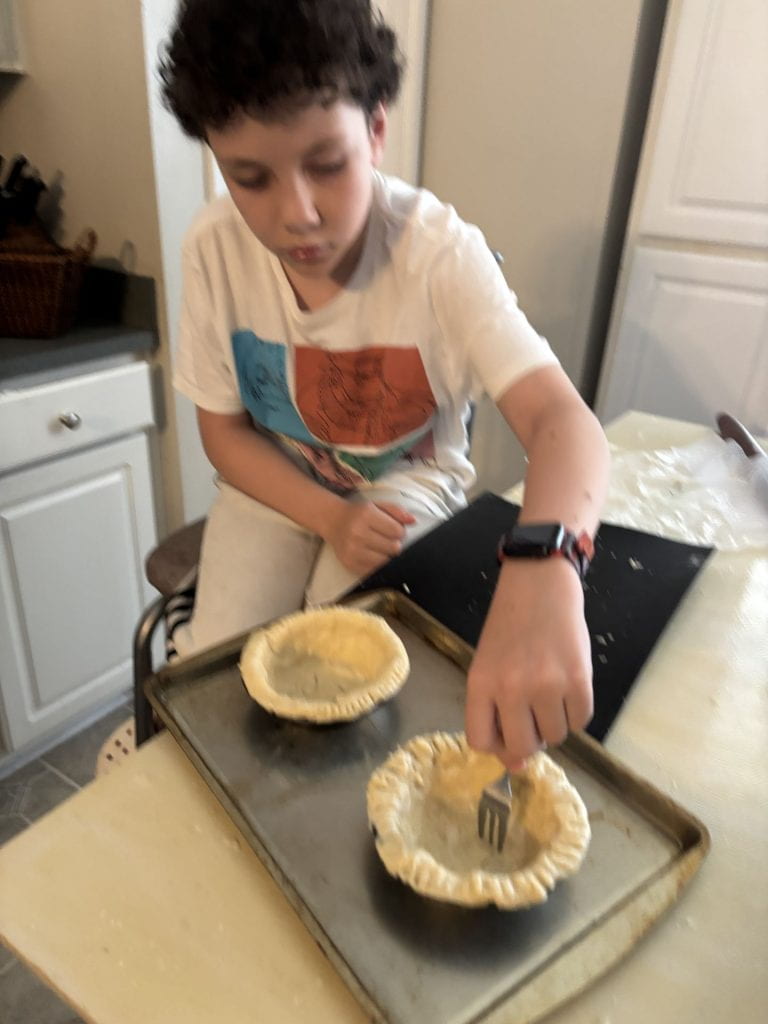
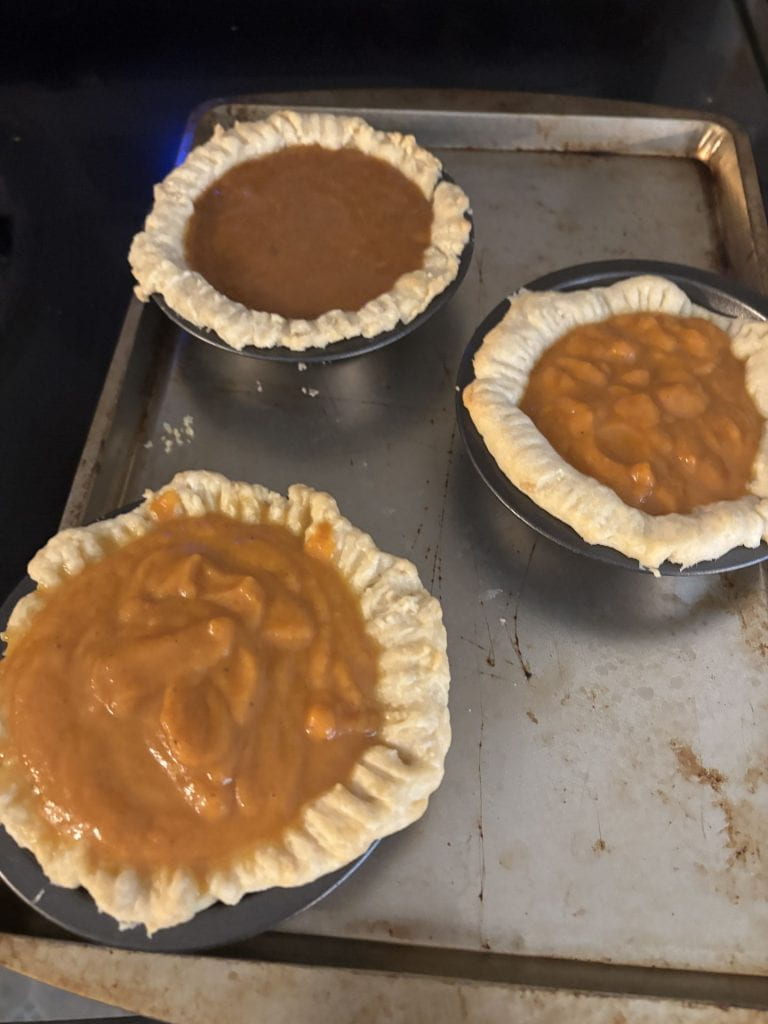
Cooking together is a powerful way to connect as a group and build community while also practicing reading/following directions, creative expression, and math skills. This week we made individual pumpkin pies 🙂
Reading – Writer’s Workshop
The kids have a deadline of the end of this week to finish their individual writing projects. We will make a plan this week for the writer’s celebration that will follow to share their writing projects.
Ollie grew in his writing by including show not tell elements in his second short story. Sterling is pulling her short stories together into one connected book and working on editing dialogue in her book. Laurence is working on sticking to a storyline and connecting all the elements in his graphic story so that he finishes one complete story. Luka is writing the first 3 chapters of what will be a longer novel and we work together this week to thread and connect the ideas for their story together. Lili just began writing her first story this week about a clan of cats. It will be exciting to read how her story unfolds.
Luka began reading “Hunger Games” this week, Laurence started a graphic novel on WWI, Ollie is reading ” Chasing the Falconers” while Sterling is continuing to read the next book in her mystery series while Lili is also reading a next book in the Warrior Cat Series. I am sharing with all the kids that it is important to challenge themselves to grow their capacity to read at more complex levels by choosing books that help them to grow. Choosing a variety of genres rather than sticking to a favorite is also an important way to grow as a reader.
As we are a learning community, our goal in building a community is to support and inspire one another as we work towards meeting our learning goals. This week we worked on understanding some of the skills we will need to accomplish this. This project threads through all of our academic areas as we work towards building the skills needed to live in our community and in an interconnected, interdependent global world. We will continue with this unit into October. Our next project for this year is The Future City Project.
News for This Week:
The home learning call on Friday at 9:30 worked great! The kids had a chance to ask questions and clarify what they needed to accomplish and hopefully, it supports setting up the routine of doing home learning at a certain time/space on a Friday. Thanks to Luka for this great suggestion! I am keeping a record of all the home learning completed. Home learning is a great chance to build integrity, self-discipline and the goal of seeing learning as a lifelong process that belongs to each of them.
Once I finish goal setting with each of the kids, I would like to share these with each of you and get your thoughts and input. Working as a team will support the kids meeting their learning goals 🙂 Here is the video we will watch this week before we begin to set goals. Here is our goal setting sheet. They will have a goal setting page on their digital portfolios.
The plan is for Lili to gradually transition from Talent School to Bridges Academy. For now, she will come on Mondays, when Scott is here as well and on Thursdays. I will be adding Angela, Lili’s mom to our group chat today 🙂
Science
As part of NC Science Standards for learning about the interactions of living and nonliving things on our planet through our Community Project, we learned about animal/insect groups and how some are social and work together while others are solitary. The kids each chose animals/insects they were interested in, did brief research to see if they were social or solitary and then chose a social animal to research and share with the group. Ollie chose sharks, Luka researched bees, Sterling learned about dogs and Laurence found out more about sea otters. They researched and recorded information and then chose a way to present their findings to the group.
We noticed some connections between the kinds of things that all the animals/insects do when they work together in community for survival: parenting young, defending/protecting, foraging for food, and specialized roles and did a wider internet scavenger hunt to find out about more animals/insects and how they performed their social roles. We also researched some of the solitary animals to see how they function differently to get their needs met.
On Thursday, we did a field trip to “Jetton Park” to explore animals and insects in nature and take photos of those we observed. On Monday, we will sort these groups by researching to find out which are social and which are solitary. The kids got great photos of a squirrel with a nut in his mouth, a butterfly staying still right in front of us, a lizard on a tree, ants on the ground and more!
Math
As the kids are now either in or moving towards middle school, the math is getting more complicated and multiple skills are needed to solve problems. Lots of them love to do math in their head and most of the time now, they need to have the patience and stamina to write math work down and figure it out step by step. This is great daily practice for working towards being able to achieve long term gratification. I got a set of whiteboards to help support figuring out math by hand and to use as a teaching tool when I work side by side with them on their math.
I have put them off calculators for now, beyond checking their answers, to make sure all have practice at the long division, multiplication, addition and subtraction skills needed to solve more complex problems. Some of them are solidifying their math fact memorization skills as well.
They are each moving at their own pace and some have checkpoints at the end of each unit now to check whether they can apply the math they learned in a given unit.
Writing Workshop/Book Club
Most of the kids are nearly finished with their first book of choice and will make choices this weekend or next week to find a new book. I have been having conversations this week with those that will soon finish to help them find next books.
We are writing nearly every day in response to our reading including practicing skills like: Summarizing what has been read, sharing their understanding/making connections to what they read, vocabulary development, predicting what will happen next etc. We are also sharing our reading and writing book club style so the kids have a chance to connect to one another’s books and relate these to our understanding of community through the different communities present in each of their books.
This week I shared the idea of “reading like writers” by asking them to notice a moment in their books where the author shows rather than tells to develop a character in the book. I gave them an example from Charlotte’s Web and they shared the examples they came up with in their own books. This is an example of the mini-lessons I do as a way to help them improve their individual writing.
I conferenced with all the kids on the writer’s workshop writing they are each working on and made suggestions on what is amazing about their writing and offered a suggestion for something to work on. Sterling worked on editing the grammar of the amazing dialogue she created in the mystery she’s writing. Laurence and I sat side by side while he talked out his story and began to put the pictures and words of his first few pages together. His goal is to stick with writing his graphic story until it is finished and stay on track with his story line. Ollie is using the show rather than tell tip I shared in our mini lesson to make readers care and feel something about his characters. He connected to when we watch a movie, and we care about the characters and feel something when events unfold on screen and that this could be similar in his writing. Luka’s goal is also to finish the short story they are writing. They switched from writing a graphic story to a fiction piece with some illustration to make it more achievable to finish.
We made a deadline of two more weeks to complete our finished writing piece and are planning a writer’s celebration to share our work. More to come on this 🙂
Social Emotional Awareness/Social Studies:
Instant / Long-term Gratification: Our book club sharing created an opportunity to talk about short term as compared to long term gratification. Sterling gave a great example of both when she said “getting a pet can give you instant gratification when you first get it, but when you spend time feeding it, walking it, caring for it and building a relationship together, you get the long-term gratification of having a pet.” We talked about the choices we make and how much harder it can be to choose to delay instant gratification in favor of attaining a longer-term goal. To meet our longer term goals, we need to reflect on our choices to see if they align with our goal. I shared that building the stamina to stick with a project until it is finished is building long term gratification skills: like finishing the stories they write during writer’s workshop or doing the multi-step math problems and concentrating long enough to figure them out. They all agreed that practicing how to delay our first impulse in favor sticking with something until it is finished is a life skill that we all need, and I shared that it is a skill we strengthen over time as we do it, like a muscle. This conversation helped to open up the individual goal setting we will do next week.
Building Trust and Supportive Relationships Helps us to Listen to the Positive and Negative Feedback we all need to Grow: We watched a clip of “The British Baking Show” as a way to notice how the bakers on the show are able to listen to both positive and negative feedback about their baking because they know their fellow bakers and judges care about them and are in support of their growth as bakers. The bakers listen to the judges and receive the feedback they give because they trust that the judges and fellow bakers are all looking out for them and trying to support their growth. Since the bakers have a long-term goal of improving their baking skills, they listen and adjust their choices using the feedback.
Emotional Intelligence: Lydia, a licensed therapist, came this week to teach us about relationship building and mindfulness. We learned that mindfulness is paying attention to what we are feeling and thinking so we can respond to ourselves and others rather than react. We did lots of different activities to practice sharing positive feedback about ourselves and our classmates, calming exercises that we can use to notice how we are feeling and our body signals so we can pause, regulate and respond with intention.